
Windows have their own vocabulary, and most of us never learn it until something goes wrong. Maybe the lower sash in your Wauwatosa bungalow won’t stay up, or there’s fog trapped between the panes of a window in your Brookfield kitchen. Knowing the parts of a window helps you describe the problem, understand your options and ask better questions when you’re planning a replacement.
Quick Answer: What Are the Parts of a Window?
A window is made of three main pieces. The frame is fixed to the wall opening. The sash sits inside the frame and holds the glass. The glazing is the glass itself, usually two or more sealed panes. Locks, weatherstripping, grilles and interior trim round out the rest. Here’s what each part means:
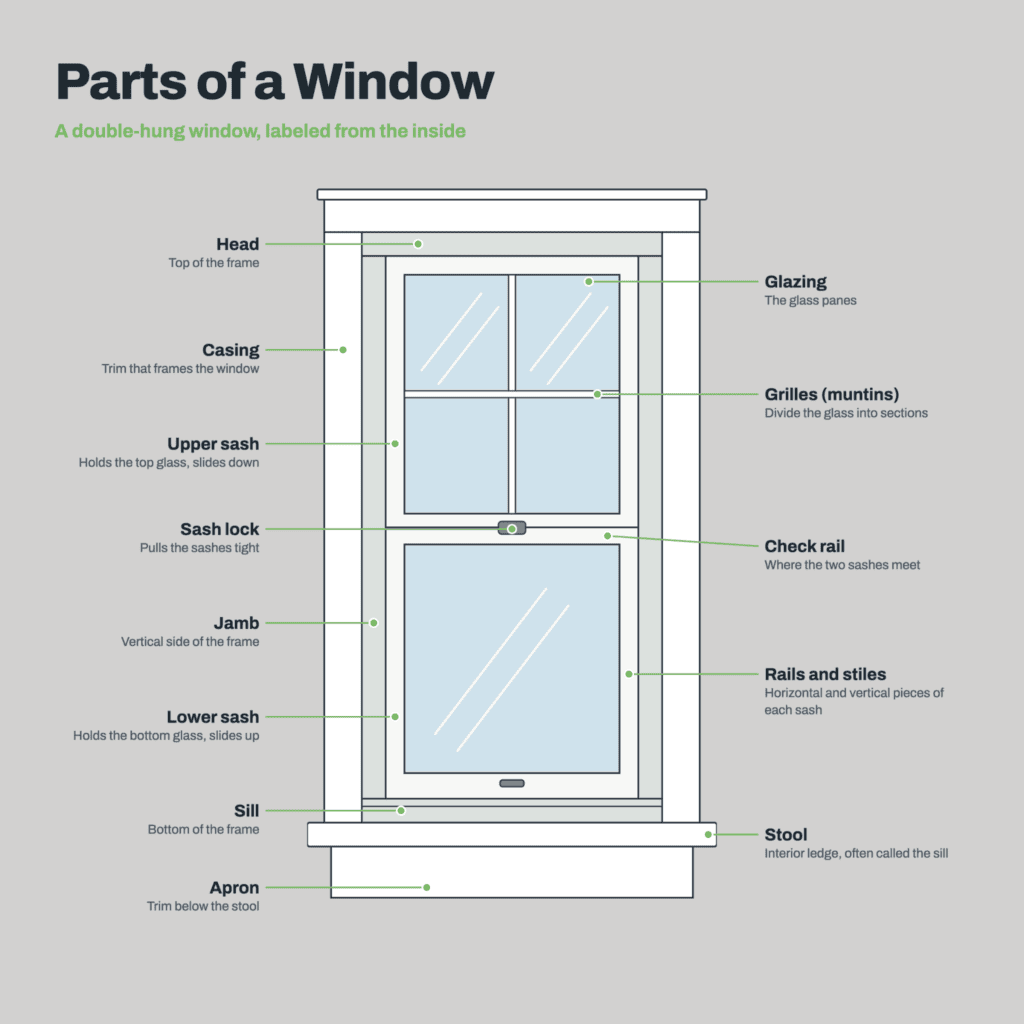
- Frame: the outer structure that holds the whole window
- Head: the top of the frame
- Jamb: either vertical side of the frame
- Sill: the bottom of the frame, angled to drain water
- Sash: the unit that holds the glass and usually opens
- Rails and stiles: the horizontal and vertical pieces of the sash
- Glazing: the glass panes
- Spacer: the sealed edge that keeps the panes apart
- Muntins and grilles: strips that divide the glass into sections
- Mullion: the joint that connects two separate windows
- Weatherstripping: the seal that blocks drafts around the sash
- Casing, stool and apron: interior trim around and below the window
Parts of a Window Frame
The frame is the part of the window that never moves. It’s made up of the head at the top, a jamb on each side and the sill at the bottom.
The sill deserves extra attention in southeastern Wisconsin. It’s sloped so water runs away from the house, but snow, ice and wind off Lake Michigan put it through a lot in places like Racine and Kenosha. A sill that feels soft or shows peeling paint is often the first sign that moisture is getting into the frame.
Frame material plays a big role in comfort. According to the U.S. Department of Energy, metal frames conduct heat rapidly, while composite frames offer strong thermal performance and resist moisture and decay. Renewal by Andersen windows are built with Fibrex® composite material, which combines the strength of wood with the low maintenance of vinyl.
The frame also determines how a window is installed. An insert replacement keeps the existing frame, while a full-frame replacement removes it down to the rough opening. Our guide to full-frame vs. insert window replacement explains when each one makes sense.
Parts of a Window Sash
The sash holds the glass and fits inside the frame. Its horizontal pieces are called rails, and its vertical pieces are called stiles. How the sash moves is what separates one window style from another:
- Double-hung windows have two sashes that slide up and down.
- Casement windows have one sash hinged on the side that cranks open.
- Awning windows are hinged at the top and open outward from the bottom.
- Sliding windows move side to side, and picture windows have a fixed sash that doesn’t open.
For double-hung or sliding, the spot where the two sashes overlap is called the check rail or meeting rail. The sash lock sits here and pulls the sashes together to seal out air.
Glass, Coatings and Spacers
Glazing is the glass in your window. Most modern windows use an insulating glass unit with two or more panes and a sealed space between them. That space is often filled with argon or krypton gas, which slows heat loss better than air.
Low-E coatings are ultra-thin metallic layers on the glass that reflect heat back toward its source, keeping warmth in during a Milwaukee winter and out during a humid July. Renewal by Andersen offers several High-Performance Low-E4® glass options, including SmartSun™ glass and SmartSun™ glass with HeatLock® technology.
The spacer lines the edge of the glass, keeping the panes evenly apart and sealing the unit. Renewal by Andersen uses a low-conductivity stainless steel spacer that resists heat transfer better than aluminum. Learn more in our post on the role of window spacers.
When comparing windows, check the National Fenestration Rating Council (NFRC) label. It lists independent ratings, including U-factor, solar heat gain and visible light.
Muntins vs. Mullions vs. Grilles
These terms sound alike, but they mean different things:
- Muntins divide a single window’s glass into smaller sections. Historically, they held separate panes of glass together.
- Grilles recreate that divided-light look on modern windows. They’re a design choice that can match a Colonial in Mequon or a Craftsman in Milwaukee. Wondering if they’re right for your home? Read are window grilles worth it?
- Mullions are the structural pieces that join two or more windows into one larger opening, like the units in a bay or bow window.
A quick way to remember it: muntins split one window, and mullions join several.
Hardware and Weatherstripping
Locks secure the sash and draw it tight against the frame. Crank handles, or operators, open casement and awning windows. On double-hung windows, balances are the springs hidden in the jambs that hold the sash in place at any height. When a sash slams shut or creeps down, a worn balance is usually the cause.
Weatherstripping lines the gaps where the sash meets the frame. It compresses each time the window closes, and over the years it can flatten, crack or pull loose. That’s when drafts start.
Interior Trim and Screens
- Casing: the trim that frames the window on the inside wall
- Stool: the interior ledge where plants and photos usually sit (often mistakenly called the sill)
- Apron: the trim board just below the stool
- Screen: the mesh panel that keeps insects out when the window is open
Signs a Window Part Is Failing
Homeowners in Waukesha, Menomonee Falls and West Bend tend to notice the same early warning signs:
- Fog or moisture between the panes, which points to a failed glass seal
- Drafts around a closed window, usually from worn weatherstripping
- A sash that won’t stay open or is hard to move
- Soft, cracked or peeling sills
A single issue may be fixable. When several parts are wearing out at once, it’s often time to decide whether to replace one window or all of them.
Parts of a Window FAQ
What is the frame of a window called?
The frame is simply called the window frame. Its top is the head, its sides are the jambs, and its bottom is the sill.
What is the movable part of a window called?
The movable part is the sash. It holds the glass and slides, swings or cranks open depending on the window style.
Is the windowsill inside or outside?
The sill is the bottom of the frame on the exterior. The ledge inside your home is technically called the stool.
What is the difference between a mullion and a muntin?
A mullion connects separate windows. A muntin divides the glass within one window.
See Every Detail Before You Decide
From Milwaukee and Wauwatosa to Pewaukee, New Berlin and Kenosha, Renewal by Andersen of Milwaukee helps homeowners pick the frame, glass, grilles and hardware that fit their home. Use our window and door visualizer to preview styles on your own house, or schedule an in-home consultation with our team.